The next leap in public health won’t come from AI alone
Published:
7 minute read
TL;DR
- AI can help public health agencies move from detection to decision faster.
- Four foundations make that acceleration possible: governance, data readiness, workforce readiness, and public trust.
- Agency leaders must lead across programs, setting enterprise priorities, clarifying authority and accountability, and investing in the people and processes modernization requires.
- Measure progress by the outcomes AI and better infrastructure enable: faster response, greater staff capacity, accuracy, reach, and ultimately, health impact.
Public health has made real progress over the past two decades.
According to the CDC, 85% of US emergency department visits are now available for public health situational awareness, most within 24 hours. More than 60,000 healthcare facilities actively send electronic initial case reports. Provisional mortality data now arrives within 10 days for 69% of records, up from just 10% in 2010. And public health receives roughly 360,000 laboratory specimen results each day across 167 medical conditions.
Most of that progress was achieved before today’s wave of generative AI became practical for public agencies.
Now a new generation of AI tools offers the potential to accelerate parts of the cycle from detection to decision. In bounded use cases, work that once took days or weeks may be completed in hours. But that acceleration depends on four foundations: clear rules for sharing and using data, connected systems, a workforce prepared to evaluate AI-supported outputs, and public trust built through meaningful participation.
Many agencies still have gaps across more than one of these areas. AI cannot close those gaps on its own.
Why modernization takes more than a platform
Before the pandemic, slow and fragmented reporting rarely attracted sustained public attention. These days, delays can become headlines. COVID changed what the public and elected officials expect from public health.
Agencies made major technology investments with pandemic-era funding. But in many agencies, the operational value has not yet matched the technical capability. Data remain difficult to acquire or standardize, workflows have not been redesigned or automated, and decision paths are often unclear.
Technology can be difficult. The larger challenge is often aligning authority, incentives, workflow, and trust around it.
The challenge starts with how public health funding evolved. Categorical funding has reinforced this fragmentation. Programs are often accountable to different grants, measures, reporting schedules, and systems. That structure creates genuine depth within programs, but it makes a shared enterprise view difficult to build. Two teams down the same hallway can be tracking the same community without being able to use each other’s data.
That’s why too many public health professionals spend their days chasing data instead of using it: epidemiologists who should be finding signals are cleaning spreadsheets.
Program leaders can’t fix this on their own, because each one is doing exactly what their funding requires. Someone above the programs must explain why combining the data is worth doing, what communities gain from it, and what it costs to leave things as they are.
Leadership cannot eliminate statutory limits, grant requirements, procurement constraints, or workforce shortages. But it can make those constraints visible, establish enterprise priorities within them, and decide where coordination is possible.
In many agencies, that cross-program work has moved slowly. The political experience of the pandemic understandably made some leaders more cautious about cross-program data sharing and public communication. But caution has a cost: decisions get deferred, fragmentation persists, and staff continue absorbing the operational burden.
Four things AI can’t build for you
Say a leader takes that risk anyway. What comes next is four interconnected pieces of work. Technology and outside support can accelerate each one, but the agency cannot outsource the leadership, decisions, relationships, and accountability involved. All four have to move together. Governance often becomes the limiting factor because it provides the structure that allows the other three to scale.
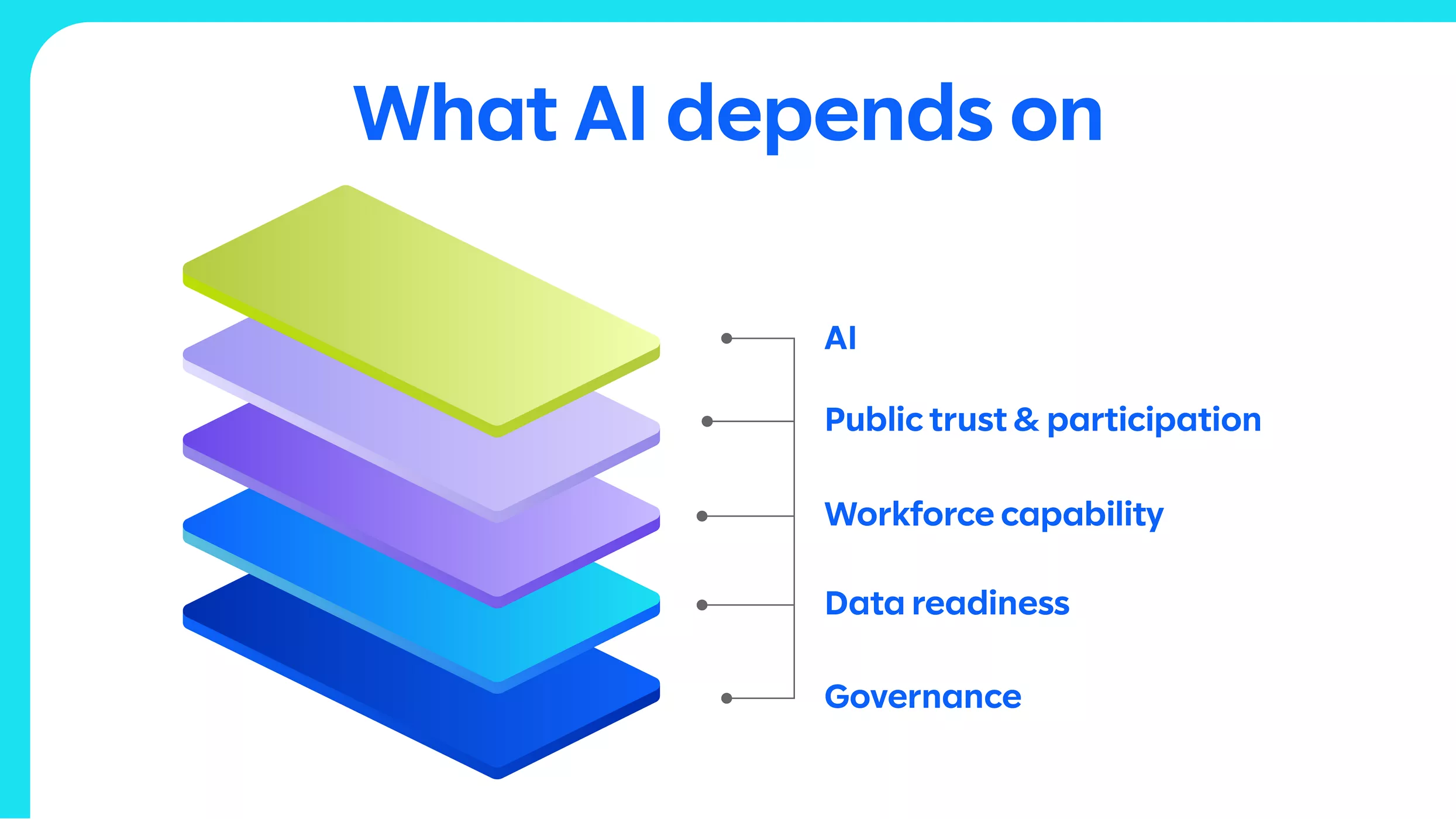
These critical pieces are as follows:
1. Governance. Governance sounds like paperwork, but it matters for determining agreements about who gets to use which data, for what purpose, and with what protections. It also defines who makes decisions, who is accountable for data quality, how disputes are resolved, and how AI-enabled outputs are reviewed. Those agreements allow a program to share its data while retaining a voice in how the data are used. They’re also what allow you to tell the public their health information is protected and to be believed when you do. Governance takes sustained work, and progress elsewhere can unravel when decision rights and accountability remain unclear.
2. Data readiness. The current problems with data come down to delay, duplication, and systems that don’t talk to each other. Behind all three of these issues sits a question most agencies have not fully resolved. When a program collects data, is it merely the custodian, or can the agency govern and reuse that data for authorized enterprise purposes? Until you answer that, technical fixes keep coming.
3. Workforce. Some disease surveillance teams have used statistical detection and machine-learning techniques for years. The new challenge is deciding where newer AI methods add value, how their outputs should be validated, and when human judgment must remain decisive.
4. Public trust and participation. People can be skeptical about government holding their health information, and a press release won’t change that. It takes a real back-and-forth. Community forums, working groups, and sustained conversations can reveal what people value, what risks they see, what protections they expect, and where they want a voice in the decision. It also takes keeping your word. Break trust once, and you’ll spend years earning it back.
Most leaps in public health have worked this way
That’s a lot of work to do before technology does anything for you. The pattern is familiar from many of public health’s greatest advances: A new capability creates potential, but communities still need standards, infrastructure, institutions, and people to translate that potential into impact.
Take clean water. Knowing that pathogens traveled through water saved no one by itself. Communities had to build sewer systems, write standards defining what sanitation meant, and fund the inspection and maintenance that kept the systems and the standards working. Any one of those alone would have failed. Together, those measures dramatically reduced waterborne disease and made safe water a dependable public health capability rather than scientific insight alone.
Same with vaccines. Eradicating smallpox required far more than a vaccine. It took production and delivery capacity, trained workers, case finding, surveillance and containment, international coordination, and sustained local execution.
This time, AI is not the discovery. It is the new accelerator.
Governance, interoperable data, workforce capability, and trust determine whether that acceleration produces better decisions or simply faster noise.
How you’ll know it’s working
Knowing these things doesn’t tell you whether your own agency is getting anywhere. Start with what goes wrong. Three patterns stall even the agencies that actively want to pursue modernization. Some take on too much at once until nothing moves. Some run so many pilots that none of them lead anywhere. And many fund the technology while leaving the human work unstaffed.
In my experience, the third is especially common. Governance takes someone to lead it. Community outreach takes people who can sit in neighborhoods and listen. Change management takes staff. Inside a single program, funding any of that means not filling an open position that would deliver services today. Program leaders will typically choose today’s opening. They’re right to do so because that’s what they’re accountable for, which is why someone above the program level has to make that call.
Once that call gets made, some of the earliest benefits will impact your existing staff. Better infrastructure should return capacity to existing staff by reducing avoidable administrative work, from assembling grant reports and reconciling financial data to coordinating field operations.
One of the clearest measures is response time: how long does it take to move from a credible signal to an appropriate intervention? Track that alongside accuracy, reach, and health impact. When a foodborne outbreak surfaces, faster, reliable analysis can support earlier intervention and potentially reduce additional illness. Do that consistently, and your agency becomes better positioned to contain outbreaks earlier and prevent avoidable impacts.
Speed only helps if someone can tell what the data is pointing toward. AI can help with the science of public health, but the art of public health stays human. A dataset may locate someone by address, ZIP code, census tract, or service area. But those administrative boundaries rarely capture the full community a person experiences, including where they live, learn, work, worship, and play: a neighborhood, congregation, tribal community, school network, or a few blocks understood locally as one place.
Reading the difference takes someone who knows the area. Build the foundation so that your staff spends their time on that judgment instead of cleaning data.
Where to start today
Every one of these four is something you can start now. Governance comes first, with the other three moving alongside it.
- Who has authority to use the data, and for what purpose?
- Can the necessary data move across programs in a usable form?
- Do staff know when to rely on an AI-supported insight and when to challenge it?
- Were communities involved in deciding how their information will be used?
If the answers are unclear, buying AI will not resolve them. It may only expose them faster.
AI is not the leap by itself. The leap happens when agencies combine modern tools with clear authority, connected data, capable people, and public legitimacy, then use that foundation to move from signal to action faster and more responsibly.
Slalom helps public health agencies build these foundations, from governance and connected data to workforce adoption and change. The decisions and public accountability remain with the agency. If your organization is assessing its readiness, our public health team would welcome the conversation.