What AI-PDLC unlocks that traditional PDLC can’t
How an AI product development lifecycle (AI-PDLC) transforms every product decision with evidence instead of assumptions
Published:
5 minute read
TL;DR
- The product development lifecycle itself is changing because AI changes how organizations learn. AI-PDLC is the new advantage, and it must be designed as an organizational capability requiring cross-functional collaboration.
- Product doesn’t own AI-PDLC. Neither does engineering or IT. AI-PDLC is a shared capability spanning across strategy, product, data, engineering, design, operations, risk management, change management, and AI modernization.
If AI touched every activity in product development, what would change?
Most organizations think about AI in the context of engineering productivity—code generation, copilots, and automation. That's important, but it's only one small part of the opportunity. It’s not about how much you can sling or how many features you can build; it’s about solving the right problems and identifying untapped opportunities to create new value.
A mature AI-PDLC applies AI across the entire product development lifecycle, creating a continuous feedback loop from customer insight to product launch and ongoing optimization. This approach changes everything about what decisions you’re making.
Instead of a sequence of static actions, lifecycle becomes a dynamic cycle:
PDLC:
- Annual planning → Quarterly roadmap → Sprint (Design, Build, Test, Deploy) → Release
- It’s all based on assumptions (though, hopefully, with at least siloed feedback loops).
- Time-to-value is in months, and value is a gamble.
AI-PDLC:
- Continuous sensing/Pattern detection → Opportunities/Ideation → Test, experiment, learn, refine → Develop/Deploy → Measure → Adapt/Optimize
- It’s all based on evidence from interconnected feedback loops.
- Time-to-value is in days, not months.
Why AI-PDLC is better than traditional PDLC
Reason 1: Adaptive beats static
In product development lifecycles that only use AI to speed up development/engineering, requirements freeze. They’re stuck in a static status that constrains adaptability and creates opportunity costs. At least until the next scheduled review cycle, which could be weeks (and usually months) too late to capitalize on the new inputs.
In AI-PDLC, requirements are evolving, often in real time. AI can accelerate (automate or make decisions) around how to adapt to usage, support tickets, telemetry, operational data, and customer conversations.
Reason 2: Speed meets intelligence for new enterprise memory
AI-PDLC captures customer insights, business strategy, budgetary constraints, product vision, engineering knowledge, architectural decisions, workflow improvements, and business outcomes, so iterations aren’t just faster—they’re smarter, too. Code might live at the center of the PDLC, but what code unlocks for decision quality and business outcomes—that’s the real treasure.
Reason 3: KPIs tie more tightly to what matters to the business
Traditional PDLC reports back interesting performance indicators like velocity, sprint points, releases, and defects. But AI-PDLC metrics unpack higher value. With AI-PDLC, you can measure validated learning velocity, decision confidence, reuse, workflow improvement, AI adoption and fluency, and business outcomes.
How AI-PDLC changes product decisions
Here’s how AI-PDLC changes decision-making across the product lifecycle:
Traditional PDLC vs. AI-PDLC: better decisions at every stage
|
PDLC activity |
Yesterday’s decision (without AI-PDLC) |
Tomorrow’s decision (with AI-PDLC) |
|---|---|---|
|
Customer sensing |
What should we build? |
Which unmet customer needs are emerging right now? |
|
Product research and prioritization |
Which ideas seem promising? |
Which opportunities have the strongest evidence and business value? |
|
Opportunities and ideation |
What features should we include? |
Which customer outcomes matter most, and what can wait?
How do we validate assumptions and unknowns? |
|
Solution design |
Which architecture should we choose? |
Which solution delivers the best balance of speed, cost, risk, and scalability? |
|
Engineering delivery |
Can we ship? |
What's the fastest safe path to production? |
|
Testing and validation |
Did the software pass QA? |
Where is the greatest risk before customers ever see this? |
|
Product launch |
Did customers like it? |
What should we change tomorrow? |
|
Continuous learning |
What should we build next? |
What do we already know about what customers need? |
Enabling the AI product development lifecycle
When your organization bites off AI transformation initiatives, you’ve got to treat AI like a capability (ongoing), not like a project (done). Likewise, once you’re moving from ambition into execution, you’ve got to embed AI as a continuous capability across the entire product development lifecycle—not as an accelerator for singular parts of the process.
We call that enabling AI (aka putting AI in motion).
At a high level, here’s what that looks like when AI operates across the product development life cycle:
The adaptive AI-PDLC
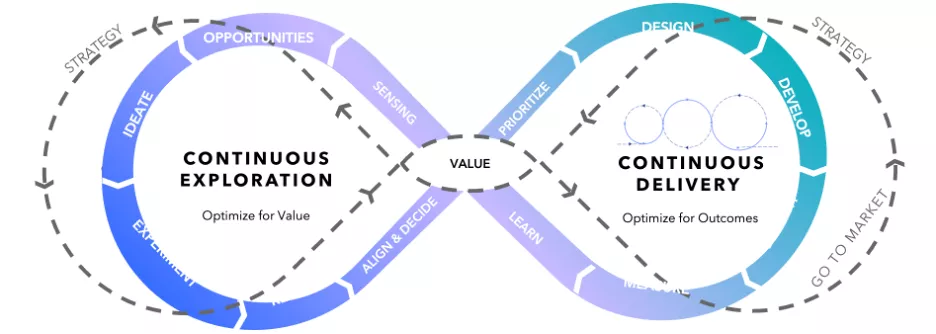
- During exploration, AI helps surface patterns, name opportunities, analyze customer feedback, and generate ideas.
- During delivery, AI accelerates design, testing, coding, quality, documentation, and deployment.
- After launch, AI analyzes usage data, monitors performance, and recommends improvements.
- The insights AI generates into outcomes also inform an infinity loop of feedback into the next cycle, helping teams continuously improve both the product and how they build it.
That said, understanding the AI-PDLC is one thing. Building the organizational capability to sustain it is another.
Many organizations already have AI pilots. Some have agents and copilots. Others have isolated AI products. But very few have an AI operating model that continuously turns ideas into production systems, measures outcomes, and feeds those insights back into the next generation of products.
That's where AI enablement with AI-PDLC comes in.
How AI-PDLC becomes an operating capability
AI-PDLC is the transformation layer that spans the entire AI lifecycle—from strategy and governance through solution incubation, scaled engineering, and enterprise enablement. It’s both a skeleton and connective tissue that underpins and accelerates every AI initiative.
Unlike point offerings focused on a specific phase, AI-PDLC spans the full AI journey.
What AI-PDLC looks like from problem to solution
|
If you’re asking... |
AI-PDLC stage |
Slalom solutions |
|---|---|---|
|
If you’re asking...
How do we identify the right problem or opportunity for AI investments (aka justify spend)? |
AI-PDLC stage
Prioritize value |
Slalom solutions
AI Strategy |
|
If you’re asking...
How do we govern across the enterprise? |
AI-PDLC stage
Govern and coordinate |
Slalom solutions
AI Office |
|
If you’re asking...
How do we move beyond pilots (and contain red herrings)? |
AI-PDLC stage
Validate prove value |
Slalom solutions
AI Accelerate Teams |
|
If you’re asking...
How do we scale AI beyond a handful of use cases? |
AI-PDLC stage
Scale delivery |
Slalom solutions
AI Factory |
|
If you’re asking...
How do we get consistent adoption across teams? |
AI-PDLC stage
Drive adoption and behavior change |
Slalom solutions
AI Enablement |
|
If you’re asking...
How do we know if AI is creating business value? |
AI-PDLC stage
Measure and improve |
Slalom solutions
AI Office + AI Factory |
Key takeaway: AI-PDLC interconnects exploration, delivery, speed, and learning
Yes, AI-PDLC's capacity for speed is... speedier. Everyone wants that. There's no disputing that AI-PDLC helps organizations (not just engineers) deliver value faster—and learn faster.
But AI-PDLC connects all your organizational functions, bringing more together through a continuous cycle of decisions based in shared context, measurable outcomes, and continuous learning.
With AI-PDLC leaders can make better decisions, earlier, with more confidence. Plus, organizations can keep adapting with minimal loss, fewer opportunity costs, and less disruptive friction.
FAQs
1. What is AI-PDLC?
AI-PDLC is an AI-enabled product development lifecycle that embeds AI from signal pattern detection. The lifecycle happens across product exploration, ideation and experimentation, prioritization, solution design, delivery, adoption, measurement, and continuous improvement. Unlike AI coding assistance alone, AI-PDLC turns AI into an operating model for faster decisions, value-oriented governance, better business outcomes, and measurable product value.
2. How is AI-PDLC different from traditional PDLC?
Traditional PDLC often follows a static sequence of planning, roadmapping, sprinting, and release.
AI-PDLC creates a more adaptive cycle: observe, learn, adapt, deploy, measure, and repeat. The biggest difference is that AI-PDLC helps teams continuously learn from customers, products, operations, and outcomes, so every release improves the next decision.
3. Why does AI-PDLC matter for AI transformation?
AI-PDLC matters because AI transformation fails through isolated tools or pilots alone. It requires an operating model that connects strategy, governance, product, engineering, operations, adoption, and measurement. AI-PDLC helps organizations move from ambition to execution by embedding AI as an ongoing capability across the product development lifecycle.
4. How does AI-PDLC help organizations avoid AI pilot purgatory?
AI-PDLC helps organizations avoid pilot purgatory by connecting AI use cases to value prioritization, governance, delivery, adoption, measurement, and continuous improvement. Instead of treating AI as a one-time project, AI-PDLC creates a repeatable system for moving ideas into production, measuring outcomes, and feeding learnings back into future product decisions.
5. What business outcomes can AI-PDLC improve?
AI-PDLC can improve decision quality, engineering productivity, software delivery velocity, product relevance, AI adoption, workflow improvement, and business outcome measurement. It helps technology leaders understand where AI is creating measurable value, where investments should change, and how teams can build products that adapt to customer needs faster.