Core application modernization patterns for the agentic AI era
Nine proven modernization patterns for making core applications accessible, composable, and ready for agentic AI
Published:
9 minute read
TL;DR
- AI agents can create more value when they can securely access the business logic and data inside core applications.
- Technical and business debt can make core applications harder to change, connect, and bring into agentic AI workflows.
- The article defines nine modernization patterns for making core applications more accessible, adaptable, and ready for agentic AI.
- Modernization doesn’t require a one-size-fits-all approach: organizations can combine patterns based on their business priorities and build on early value.
Why core application modernization matters for agentic AI
The biggest barrier to enterprise AI may not be the AI itself, but its access to the business capabilities that run your company.
AI agents are becoming a new class of application users. They can reason, make decisions, and execute work, but only when they can securely act on the business logic and data at the heart of the enterprise. Much of your competitive value lives inside your core applications, where critical business processes and foundational business data come together. Many of these applications run on mainframe and midrange platforms and have served the business for decades, yet they're often difficult to understand, change, and connect.
This post introduces nine proven core application modernization patterns for preparing your core for agentic AI workflows.
Address technical and business debt
Technical debt is the accumulated weight of past shortcuts, deferred decisions, and delayed evolution inside core applications. Not all of it reflects poor choices: architectures right for their era become debt when the world moves on and the application doesn't. Tight coupling, outdated components, and thin documentation make core applications harder to change and connect, while closed interfaces and buried logic make it difficult for AI agents to access core business capabilities.
Business debt is the widening gap between what the business needs and what its applications can deliver. It shows up in critical rules that only a shrinking group of experts can explain, processes bent around system limitations, and launches that can take quarters. It seldom appears on a balance sheet, yet the enterprise pays it continuously through lost agility, missed opportunities, and rising risk.
Together, technical and business debt increase the cost of change and slow time to market. Maintenance consumes budget that should fund innovation. Yet the debt and the value live in the same place: the application's logic, data, and structure. This is where modernization needs to focus.
Prepare core applications and data for agentic AI workflows
Agentic AI sets a new standard for enterprise applications. Applications no longer serve only people and other systems. They must also serve AI agents that reason, invoke business capabilities, and complete work. To do this, agents need documented business meaning, structured data, predictable behavior, and secure access through APIs and standards such as the Model Context Protocol (MCP). Yet many mainframe applications keep their critical logic and data out of reach, locked behind closed interfaces, tightly coupled code, exotic formats, and batch processes.
Without access to the core, AI remains at the edge of the business. It can summarize documents and draft emails, but it cannot check balances, process claims, adjust orders, or post transactions. The real value emerges when agents combine trusted business capabilities into governed workflows, and that requires an open, composable core.
Opening the core does not mean loosening control. An incorrect summary is an inconvenience; an incorrect payment is a business risk. Identity, authorization, and auditability govern what an agent may discover, recommend, or execute, making the core safely callable.
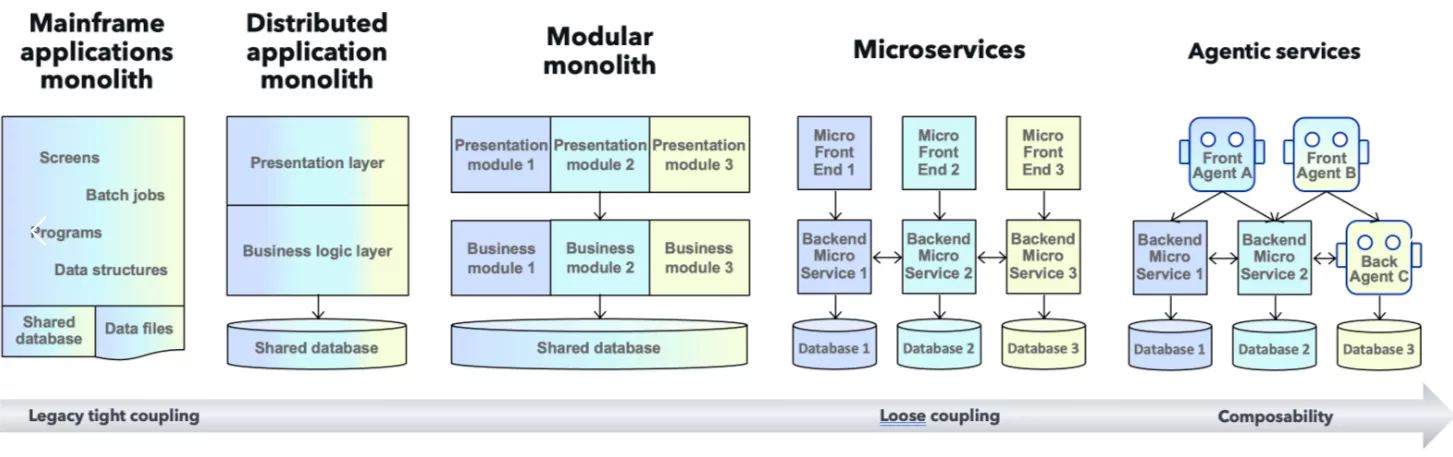
Core application evolution: from a tightly coupled monolith to composable and agentic services
Modernization creates an open, composable, and trusted foundation for people and AI agents alike. The result is a double dividend: core business capabilities become available to agentic workflows, while the applications themselves become easier and faster to evolve.
The competitive divide will increasingly separate enterprises whose AI can act on their core business capabilities from those whose AI remains disconnected from them.
Choose application modernization patterns focused on business outcomes
How do you modernize core applications? Not with a one-size-fits-all program. Every enterprise carries its own mix of technical and business debt, so the right approach depends on your business and IT priorities. The nine patterns below provide repeatable approaches for addressing different forms of technical and business debt while advancing specific business outcomes. Together, they help organizations know the core, reshape it, accelerate how it evolves, and sustain its value over time.
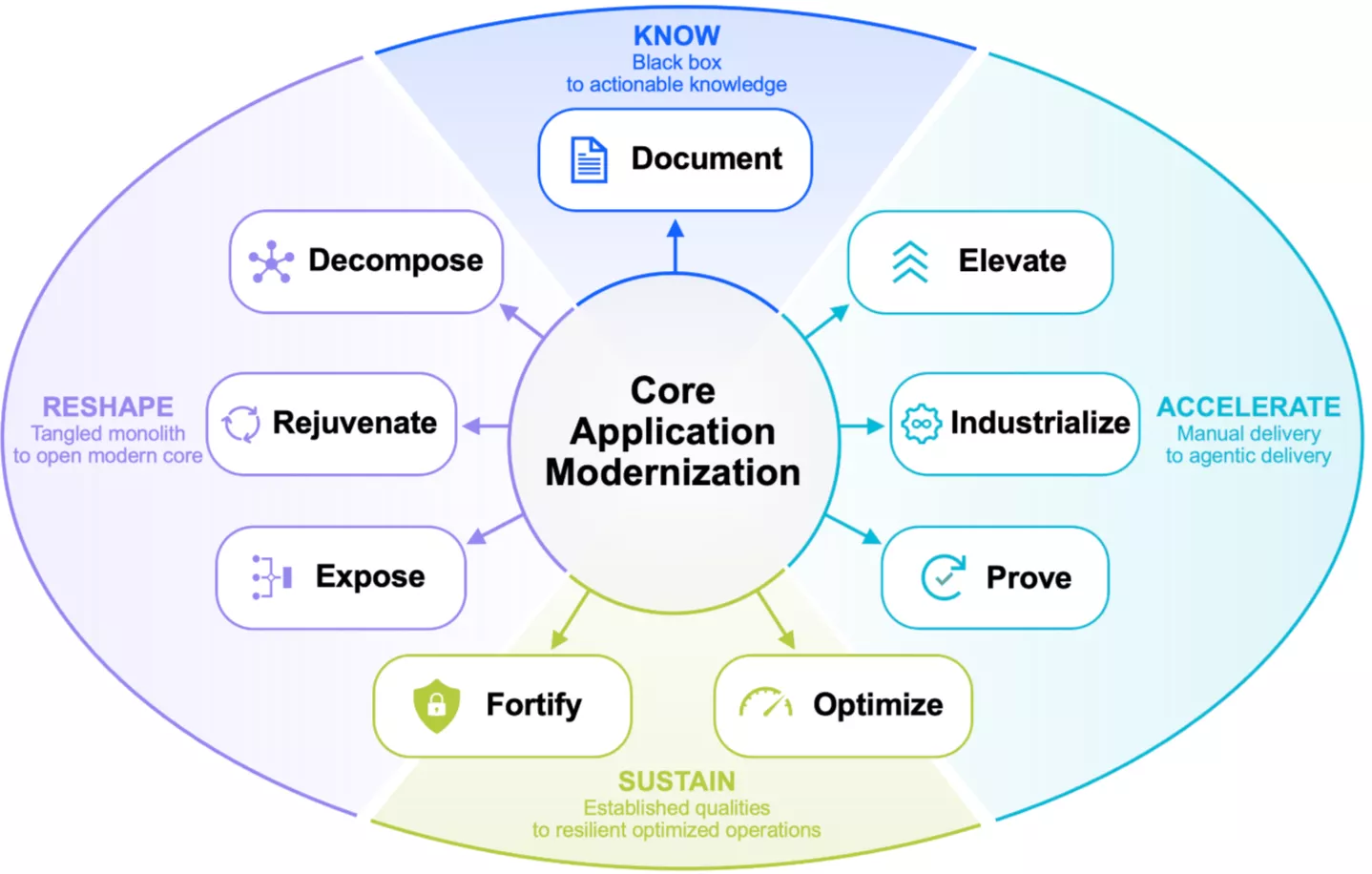
Core application modernization patterns: driven by business outcomes, centered on the application
1. Document: From black box to actionable knowledge. Decades of undocumented logic make core applications difficult to understand and change. Capturing and linking business logic, technical implementation, the data model, data lineage, and non-functional requirements, in documentation and knowledge graphs keeps the critical facts visible and queryable. This gives teams and AI agents a trusted foundation for evolving the core confidently.
2. Decompose: From tangled monolith to nimble services. A tightly coupled monolith gives every change a large blast radius, so splitting it into business-aligned services enables independent evolution, faster delivery, and more predictable outcomes with lower risk. In practice, even a small enhancement can force a full regression cycle, and one mandatory regulatory change can push the entire roadmap. The split can follow business lines, from broad domains down to individual functions and rules, or technical lines, into frontend, backend, and data layers. Domain-driven design (DDD) can guide the boundaries, with services extracted at the granularity that fits, from coarser macroservices to fine-grained microservices.
3. Rejuvenate: From aging application stack to modern, adaptable stack. An aging application stack slows adaptation and increases complexity, so modernizing and standardizing its components creates a resilient base that supports ongoing evolution, innovation, and business change. Every layer can be in play, from languages and frameworks to data formats, middleware, and platform, with the stack and its data stores standardized for scale. Options also include refreshing outdated components, packaging applications in portable stacks such as containers, and transforming batch processing into event-driven architecture. It may also involve changing the runtime, evolving subsystems, replatforming, refactoring, or reimagining the stack.
4. Expose: From locked-in logic and data to open APIs for people and AI agents. Valuable business logic and data are often trapped within legacy silos. Publishing them through standard interfaces makes core applications accessible to people, systems, and AI agents across the enterprise. In practice, those interfaces typically take the form of standard APIs and protocols that let other business domains integrate with the core cleanly. Adding Model Context Protocol (MCP) support can make them agent-ready, unlocking core logic and core data for enterprise AI agents.
5. Elevate: From writing code to expressing business intent. Old languages and sprawling codebases make every change slow, so lifting builders to express business intent as specifications while AI agents write the code moves delivery at the speed of business decisions, not programming effort. Specification-driven development can put that shift into practice, grounded in application knowledge bases and supported by modern AI-assisted integrated development environments (IDEs). Mapping business functions to their source code implementation, and back, can keep business intent and running code connected.
6. Industrialize: From manual releases to agentic delivery. Slow, manual release processes make change costly, risky, and infrequent. An automated agentic delivery pipeline with built-in quality gates enables the business to deliver improvements rapidly, reliably, and at scale. That pipeline can take shape as an AI-driven development lifecycle (AI-DLC) built on DevOps best practices, automated with continuous integration and continuous deployment (CI/CD), enriched with automatic code reviews and remediations, and guarded by quality gates so every release passes the same checks and enterprise standards. A modernization factory, a repeatable production line of skilled people and AI agents, can carry that discipline across a whole portfolio.
7. Prove: From scarce manual tests to continuous proof and feedback loops. Limited manual testing makes every change a business risk. Continuous, comprehensive automated validation against business requirements provides ongoing proof of expected behavior and gives the business confidence to evolve its core rapidly and safely. The proof can start with extensive test cases derived from the requirements and grow through feedback loops that let AI coding agents validate their own changes automatically. An automated shift-left test harness can run functional, integration, and non-functional tests early in the cycle, user acceptance tests (UAT) can confirm outcomes with the business, and AI can help troubleshoot deviations.
8. Fortify: From established qualities to best-in-class security, availability, and observability. As threats evolve and expectations rise, established operational practices must advance as well. Elevating security, availability, and observability to best-in-class standards keeps the business protected, compliant, and resilient at scale. Security can advance through DevSecOps best practices, a stack kept current with state-of-the-art security mechanisms, centralized security, and policy-driven compliance management. Availability can improve with designs for elasticity and scalability, redundancy across zones and regions, on-demand capacity, and continuous resilience testing. Observability can come from metrics, events, and alerts, feeding AIOps and automatic remediations.
9. Optimize: From over-provisioned to simplified and cost-efficient. Resources are often underutilized and architectures more complex than the business needs. Simplification and continuous capacity alignment reduce the cost of running core applications and free investment for growth and innovation. Simplification can replace complex architectures, code, and workflows with simpler ones, leaving less to run, operate, and pay for. AI-assisted operations (AIOps) can simplify the running itself, facilitating diagnosis and routine responses. The capacity alignment can draw on right-sizing, fit-for-purpose platform choices for each workload, and demand analysis based on observability data and IT insights. A FinOps discipline and greater resource-usage awareness across teams can make the savings stick.
This is an evolutionary approach: know your core, reshape it into something open and modern, accelerate delivery, and sustain it. Most projects combine several patterns, though each can also be applied on its own. Every pattern clears a specific form of debt and delivers business value in its own right, so the value you unlock early helps fund what comes next.
Speed up patterns with high-quality deterministic tools and flexible AI
Patterns tell you what to do. Tools and AI determine how fast you get there.
High-quality deterministic tools handle work that must be exact and repeatable: analyzing source code, mapping dependencies into the knowledge graph behind Document, reconciling data, and enforcing the quality gates that Industrialize and Prove rely on. They're fast, efficient, dependable, auditable, and the backbone of your modernization effort.
Flexible AI handles the work that requires reasoning and language, such as recovering business intent from code, turning that analysis into the living documentation and specifications Elevate builds on, quickly addressing the many edge cases that surface in modernization projects, and troubleshooting defects. It also lets teams build new tools and adjust existing ones as the project demands. People remain accountable for the decisions that matter.
Put them together and you get the best of both: reliability and scale from the tools, reasoning and adaptability from the AI. The tools ground the AI in facts, and the AI's output runs back through deterministic checks, so speed doesn't outrun proof. They can cut modernization timelines from years to month
Learn from our success stories
These patterns are proven, with numerous success stories published across the modernization industry. Here are two examples from Slalom's delivery work.
As furniture maker La-Z-Boy approached its 2027 centennial, core workloads that had served it well for nearly 30 years had grown complex, opaque, and risky to touch, with critical knowledge resting on two retired contractors kept on call. "Eliminating technical debt and modernizing our technology is an important part of our strategy," says Carol Lee, CIO of La-Z-Boy Incorporated. Working with Slalom, the team used deterministic tools to map the full code base and its dependencies while agentic AI recovered the business intent buried in decades-old programs. With that knowledge, the team rejuvenated priority workloads into a modern architecture, proved every step with automated tests and penny-accurate reconciliation, and optimized along the way, cutting one 20-hour job to four minutes. The results speak the language of both debts: $1.1M in year-over-year cost avoidance, a 30% reduction in overall technical debt, and a core the business can finally change with confidence.
LoyaltyOne put similar patterns to work on the AIR MILES points platform, the live, business-critical core of a coalition loyalty program serving roughly 11 million households. After nearly seven years of struggling to modernize the platform, the team documented how the system worked, decomposed the batch engine into an event-driven architecture of composable services, and proved the change with testing worthy of a system of record. The cutover landed ahead of schedule as, in LoyaltyOne's words, a total non-event, and members gained real-time points for the first time.
Get started with Slalom’s methodology
We take a business-outcome-driven and application-led approach, starting from the outcomes you want and working down to the application, not the other way around. Each phase builds evidence for the next with the minimum activities required, guided by a playbook of checkpoints refined across engagements, surfacing potential challenges early, while they're easier to address.
Workshop — Align on business outcomes, priorities, and modernization goals. Business owners and technical experts work through the business context, current state of the application portfolio, modernization options, and your target-state preferences. You leave with a shared direction.
Assessment — Get to know your core by documenting its logic, data, and dependencies. Use that insight to build the business case and roadmap. The analysis is sized to your portfolio and grounded in evidence from the source code and real usage. You come away with pattern and tool guidance, and an initial cost estimate.
Proof of value and mobilize — Apply the patterns to a meaningful slice of your estate, ending in a working proof of value. In parallel, mobilization readies everything the scale-up needs, from target architecture to operating model and plans.
Modernization at scale — Apply the patterns to the full scope with scalable mechanisms. Applications move through a repeatable modernization pipeline with quality gates and land in production, supported by the organizational and technology changes needed to sustain modernization at scale. Throughout, we also help with business-process updates, change management, and adoption.
Your commitment grows as the proof does. From the first workshop to the modernization factory at full scale, you see value early and invest in each step with confidence.
Let's unleash your core applications
Your mainframe and midrange applications are your hardest asset to change and your most valuable one to unlock. Modernizing the core makes its business logic easier to understand, its capabilities easier to access, and the applications themselves easier to evolve. That creates a stronger foundation for your people, your systems, and increasingly, your AI agents.
As agentic AI becomes part of how enterprises operate, the ability to connect it securely to trusted core business capabilities will matter just as much as the AI itself. Starting is deliberately simple: a workshop to align on outcomes, an assessment to build the case, a proof of value to show results.