AI transformation across the product development lifecycle (PDLC)
Why AI-PDLC is business critical for creating immediate, adaptive, and long-term value
Published:
6 minute read
TL;DR
- AI is changing the product development lifecycle (PDLC) by changing the nature of the work and who does the work. Most engineering teams are still focused on AI for coding. That's where change must start.
- We need to focus on where value and ideas originate. Breakthroughs only happen when AI is operational across the entire product development lifecycle, from signal to idea to engineering, when PDLC turns into adaptive AI-PDLC. Otherwise, you’re just shifting the bottleneck from one place to another.
AI has never been easier to build—or harder to get right
Our Global AI Insights Survey reveals that 91% of organizations planned to increase AI spending this year, but there a huge gap between ambitious investments and predictable outcomes:
- Only 39% of business and technology leaders can measure ROI.
- Only 28% have embedded AI into workflows.
- 50% are still constrained by legacy systems.
- And engineering teams are being asked to spin code into gold.
While enterprise leaders are still (appropriately) concerned about AI deployment decisions, governance, and adoption issues, the most effective leaders are recentering around a bigger lever: AI enablement in the heart of product operations.
Deploying AI is not the same as ingraining AI into the core of your product operations.
AI deployment vs. AI enablement
AI deployment happens when a large enterprise buys, say, 900+ GitHub Copilot licenses. The press release celebrating the partnership goes out. Everyone exhales—but the change doesn’t bring new or incremental value into the organization.
AI enablement is an operating model that embeds AI into every activity of product delivery:
- Signal sensing/analysis and problem framing
- Visioning, opportunity ideation, and strategy
- Experimentation, prototyping, and testing
- Prioritizing, engineering, and deployment
- Monitoring, adoption, optimization, and continuous learning.
It’s continuous exploration and delivery for impact, not just speed.
- It’s not a one-directional pathway to release.
- It’s a multi-directional intersection where rapid learning keeps compounding without lag and drag.
Think of it this way...
With AI deployment, you’ve made one change: you’re running something new in the stack. With AI enablement, everything is changing:
- Proactive sensing and analysis of customer, market, economic, and regulatory factors happen.
- Customer research and product management’s focus on problem solving and value creation lead and inform engineering decisions.
- New capacity for deeper problem solving, ideation, experimentation, and innovation emerges.
- Coding standards have changed (for the better).
- Teams have (and use) proven prompt skills.
- Leaders can measurably track and understand the relationships between efficiency, throughput, quality, and resilience.
- Security, compliance and regulatory reviews are baked in and happen in real time.
- Costs are monitored and proactively managed to justify ongoing investment.
- The team is cohesively, consistently performing in your new operating model.
And the organization is seeing results.
What business outcomes are powered by AI-PDLC?
Business outcomes powered by AI-PDLC
|
Outcome category |
Outcome examples |
|---|---|
|
Outcome category
Better product and investment decisions |
Outcome examples
|
|
Outcome category
Accelerated time to market |
Outcome examples
|
|
Outcome category
Higher engineering performance |
Outcome examples
|
|
Outcome category
Higher product quality |
Outcome examples
|
With proper AI enablement, three to six months after an AI tool like Claude Code or Copilot is deployed, it’s part of how product strategy, management, engineering, and operations work. Business operations teams, product managers, and engineers use it every day. It’s collapsing the time between signal and action for greater value impact.
When you deploy AI, you’re using the technology. When you enable AI in the PDLC, you’re extracting business value from untapped opportunities you didn’t know existed. That’s not the same thing.
Most AI operations focus on coding, but that’s not enough. Engineering teams trying to enable AI are still stuck in the traditional product lifecycle:
Use Case → Requirements → Design → Build → Test → Release
It’s your basic Idea → Build → Deploy framework with “the need for speed” bolted on to a lifecycle that starts with opinion and ends with learning at deployment. That learning happens far too late.
But in a true, well-tuned AI-PDLC, learning and optimization happen continuously:
Explore → Identify → Design/Test → Learn → Scale → Optimize
Principles of AI-PDLC in action
The real value of an AI-PDLC is that it connects value to every action through an intelligent network of AI automation, agents, and human judgement at the helm. AI-PDLC connects the dots, so organizations benefit from speed at scale and outcomes that compound impact.
Principles of AI-PDLC in action
|
Explore the right problems |
Identify the right opportunities |
Test/Design the right solution |
Deliver the solution |
|---|---|---|---|
|
What business problems are we solving? |
What is our hypothesis of value? |
What assumptions can we validate? |
“Build” to solve it. |
|
What opportunity exists? |
Which ones are worth funding? |
How does AI fit? |
Test it. Prove value. |
|
Where can we shake out real value? |
Which ones are realistic? |
What workflow changes? |
Scale it. |
Slalom's approach to AI-PDLC solutions
Slalom’s specialized AI tools, agents, ways of working, and governance are used continuously across the PDLC lifecycle to accelerate time-to-value.
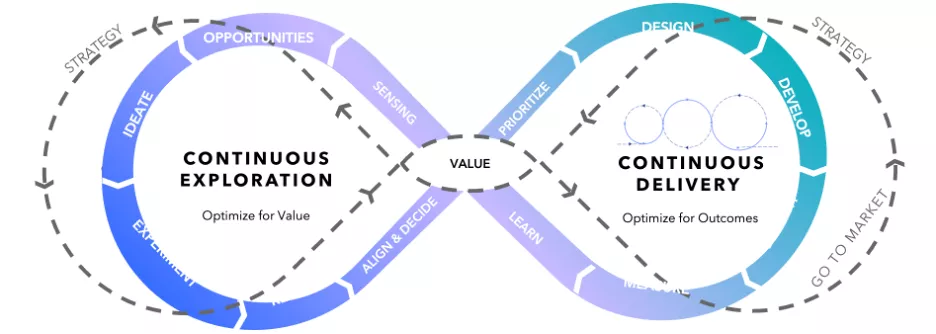
Without an AI-PDLC, organizations deploy AI as isolated tools:
- A chatbot in customer service
- A prompt library and analytics assistant for product managers
- A copilot for developers
With an AI-PDLC, AI becomes the instigator for a whole new operating model that continuously captures signals, informs decisions, accelerates delivery, and drives learning across the entire product lifecycle. This new operating model collapses the traditional business, product, and IT divide. That's the shift executive teams are increasingly looking for—not isolated AI projects but a governed, repeatable system for turning ideas and the fuel of AI into measurable business outcomes.
This shift funds the value and the capacity, not the work.
AI-PDLC solutions by industry and by phase
Here are some AI transformation solutions where Slalom and our partners like OpenAI, Amazon Web Services (AWS), GitHub Copilot, and Salesforce have strategized, co-built, and coached with AI-PDLC for adoption, outcomes, and future scalability.
The explore phase in AI-PDLC
|
Industry spotlight |
Slalom customer |
Measured business outcome |
|---|---|---|
|
Industry spotlight
Healthcare and life sciences |
Slalom customer
|
Measured business outcome
|
|
Industry spotlight
Government and social impact |
Slalom customer
Establish AI governance and operating model coordination for the Florida Division of Emergency Management.
|
Measured business outcome
|
The identify phase in AI-PDLC
|
Industry spotlight |
Slalom customer |
Measured business outcome |
|---|---|---|
|
Industry spotlight
Retail: travel and hospitality |
Slalom customer
|
Measured business outcome
|
|
Industry spotlight
Technology: software |
Slalom customer
Evaluate and prioritize Avetta’s cross-functional AI pilots for execution at scale across 120+ countries and unique compliance standards.
|
Measured business outcome
|
The test and design phase in the AI-PDLC
|
Industry spotlight |
Slalom customer |
Measured business outcome |
|---|---|---|
|
Industry spotlight
Technology |
Slalom customer
Accelerate product delivery and quality work product with AI-native engineering at Ocuco.
|
Measured business outcome
|
|
Industry spotlight
Healthcare and life sciences |
Slalom customer
Design an AI workflow with Hologic that accelerates slide-level pap test image classification in cervical cancer screening.
|
Measured business outcome
|
The delivery phase in the AI-PDLC
|
Industry spotlight |
Slalom customer |
Measured business outcome |
|---|---|---|
|
Manufacturing and mobility |
Drive AI adoption and workforce impact for GTÜ’s CoExpert, an AI assistant for Germany’s technical automotive inspections.
|
|
|
Financial services: lending |
Unlock AI readiness to add an intelligent GenAI assistant for Jaja Finance customer experience enhancement.
|
|
Key takeaway: look beyond coding productivity
The biggest value comes from connecting customer insight, product, engineering, governance, and measurement. You're not necessarily replacing tools, and you’re definitely not replacing product and engineering judgment. You’re using AI-PDLC to strengthen your business with faster signals, better context, and more adaptive execution.
Use AI to create new ways of working together:
- Examine how ideas are sourced, how use cases are selected, how opportunities and ideas are shaped, how teams test before build, how releases become the everyday norm, and how learning flows back into the next decision.
- Ask, “Where is value getting stuck across our product lifecycle—and how can AI help us remove the friction?”
AI becomes valuable when it moves through a continuous lifecycle of prioritization, governance, delivery, adoption, measurement, and improvement until it becomes an operating capability embedded into how the business runs.
FAQs
1. What is AI-PDLC?
AI-PDLC is an AI-enabled product development lifecycle that embeds AI from signal pattern detection. The lifecycle happens across product exploration, ideation and experimentation, prioritization, solution design, delivery, adoption, measurement, and continuous improvement. Unlike AI coding assistance alone, AI-PDLC turns AI into an operating model for faster decisions, value-oriented governance, better business outcomes, and measurable product value.
2. How is AI-PDLC different from using AI for coding?
AI for coding helps engineers write, review, test, or document code faster. AI-PDLC is broader. It applies AI across the full product lifecycle, including identifying the right problems to solve or untapped opportunities, discovery, ideation and experimentation, prioritization, solution design, delivery, adoption, measurement, and continuous learning. The goal is not only faster coding, but better product decisions and measurable business outcomes.
3. How does AI change each phase of the product development lifecycle?
- Explore: AI helps teams align on business problems and opportunity spaces
- Identify: AI helps prioritize use cases based on value, feasibility, and risk
- Test/Design: AI helps shape workflows, requirements, architecture, and governance
- Deliver: AI helps teams build, test, release, adopt, measure, and improve
4. What makes AI-PDLC valuable after product release?
In AI-PDLC, release is not the end of the lifecycle. After launch, AI can help teams monitor adoption, analyze feedback, detect quality issues, measure value, identify improvement opportunities, and feed learning back into planning. This turns delivery into a continuous value cycle instead of a one-time handoff.
5. What business outcomes can AI-PDLC improve?
AI-PDLC can improve engineering throughput, reduce rework, accelerate time to market, shorten idea-to-launch cycles, improve product-market fit, reduce low-value investments, strengthen release quality, and increase customer adoption. Its value comes from connecting signals, decisions, delivery, and learning across the product lifecycle instead of optimizing isolated tasks or individual phases of the PDLC.