
Stop counting APIs. Start running them like products.
Five shifts reshaping API strategy and where to focus first
Published:
7 minute read
TL;DR
- Run APIs as products, not inventory. Clear ownership, standards, visibility, and measurement help turn APIs into reusable business assets.
- AI raises the stakes for API strategy. Agentic workflows depend on reliable, secure APIs to reach real business capabilities.
- Five shifts are reshaping API strategy. AI adoption, security and resilience, modern protocols, integrated management, and product thinking are changing how APIs are run.
- Start where the pain is greatest. Focus first on your most critical APIs and the problems creating the most risk, cost, or delivery friction.
How should your API strategy evolve for AI and agentic workflows?
APIs have quietly changed jobs—from back-office plumbing to the front door of the business.
Many organizations we work with are shipping more APIs than they did a year ago. That’s the good news, and it’s also the problem. APIs now expose your most valuable capabilities to customers, partners, and increasingly to AI agents that act on your behalf. Managed well, they compound in value. Left alone, they quietly compound in cost and risk.
So the real question isn’t “Should we invest in APIs?” You already have. It’s a sharper one: are your APIs working like products, or piling up like inventory? Here’s our point of view on where API strategy is heading, why it can’t wait, and where to start.
Five shifts we’re betting on
We see five shifts reshaping API strategy. None of them is a far-off prediction. Each is already showing up in the organizations we partner with, and each will only intensify from here.
- AI turns APIs into its hands and feet. Conversational interfaces, automation, and agentic workflows create more value when AI can reach real business capabilities. APIs provide that reach. As you roll out generative AI, the quality of your API estate becomes the difference between a slick demo and a service people can depend on.
- Security and resilience move from checkbox to prerequisite. As APIs become the front door to sensitive data, protecting them is no longer a late-stage task. It’s a condition of going live, especially in regulated spaces like the public sector and higher education.
- Modern protocols go mainstream. gRPC, GraphQL, and AsyncAPI are moving from experiments to everyday choices, giving teams better performance, more flexibility, and event-driven patterns.
- Fragmented tooling consolidates. Teams are trading a patchwork of tool-specific gateways for integrated API management, so they can finally see and govern the whole estate in one place.
- APIs become products. The most important shift is mindset. Leading teams give APIs owners, roadmaps, SLAs, and a clear line to business value—which opens the door to new revenue and partnership models.
Read together, these shifts point to one conclusion: the value of your APIs now depends far less on how many you have and far more on how well you run them.
Why this can’t wait
This isn’t a someday problem. API growth compounds—and so does the cost of ignoring it. Every release cycle without clear ownership, standards, and visibility quietly adds duplicated APIs, surprise cloud bills, and a wider attack surface. The longer that goes unmanaged, the more expensive it becomes to unwind.
AI raises the stakes further. As agents begin calling your APIs to act on a customer’s behalf, dependability stops being a nice-to-have. A flaky, undocumented API no longer fails quietly in a test. It fails in front of a customer. The organizations that get deliberate about APIs early build a durable advantage; the ones that wait spend their energy untangling instead of building.
Six disciplines behind a durable API strategy
If those shifts are the “why” and the play above is the “where to start,” these six disciplines are the “how.” We don’t see API strategy as a single capability. It’s an ecosystem of disciplines that together turn scattered APIs into governed, reusable products. Each one below pairs what it does with a real-world scenario we see repeatedly—so it’s clear what “good” looks like when the discipline is missing versus mature.
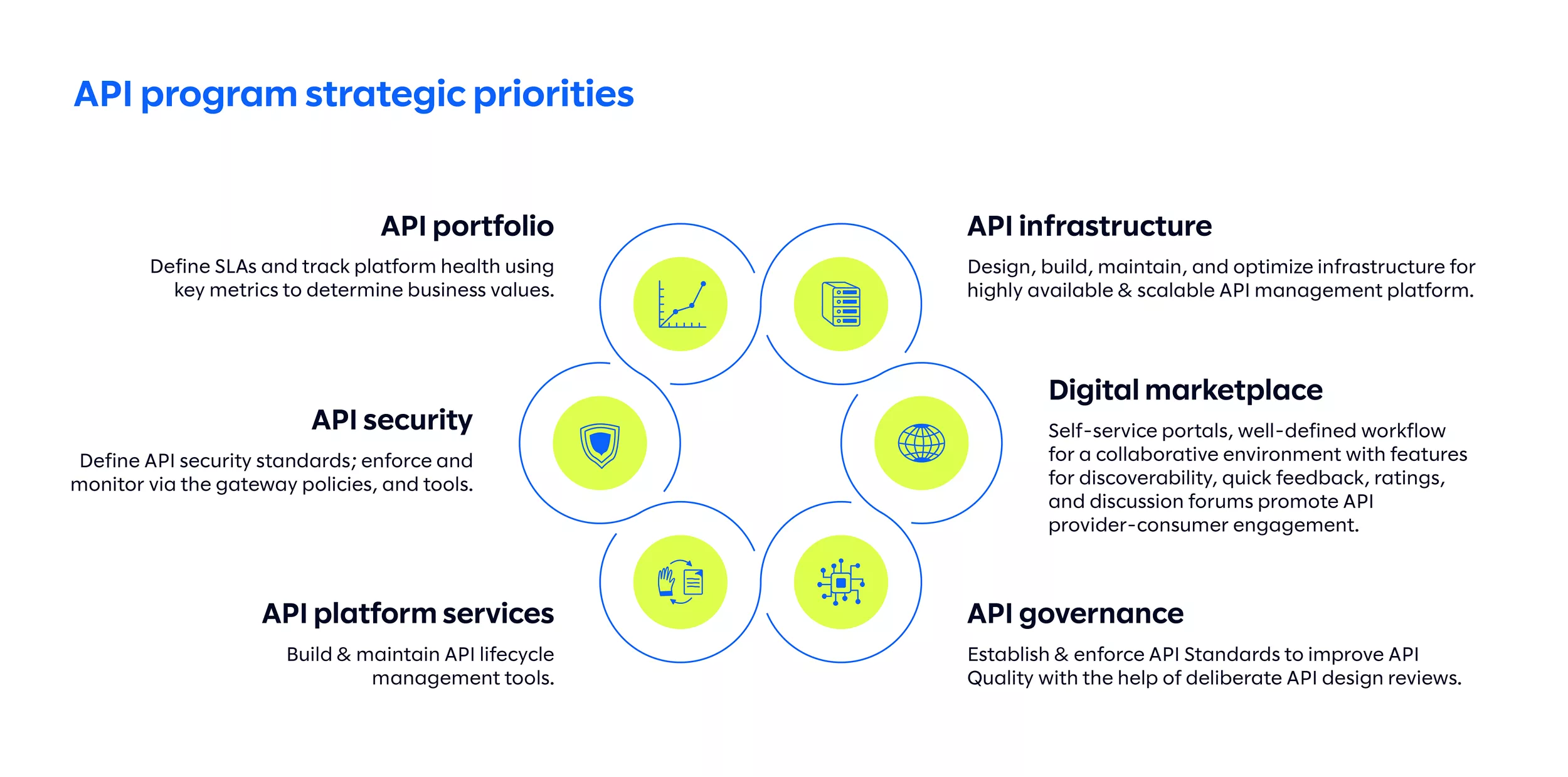
API infrastructure
A scalable, resilient foundation—gateway architecture, deployment patterns, and high availability that can carry AI-driven workloads.
API governance
Design standards, reviews, and lifecycle policies that keep APIs consistent across teams—without slowing anyone down.
Platform services
Automation for the API lifecycle—publishing, promotion, access, and documentation—so teams ship faster with stronger controls.
API security
Enterprise-wide controls, authentication, and monitoring across all API traffic—treated as a discipline, not a project add-on.
Digital marketplace
A place to discover, evaluate, and onboard to APIs, with clear documentation, ownership, and self-service.
API portfolio management
Measurement of usage, quality, cost, and value so you can rationalize, invest, and run APIs like a product portfolio.
A simple way to gauge maturity
Before you can improve, you need an honest read on where you stand. We use a plain four-stage lens you can apply to each discipline—and to individual APIs—in minutes. It’s deliberately lightweight. The point is to spark the right conversation, not to produce a perfect score.
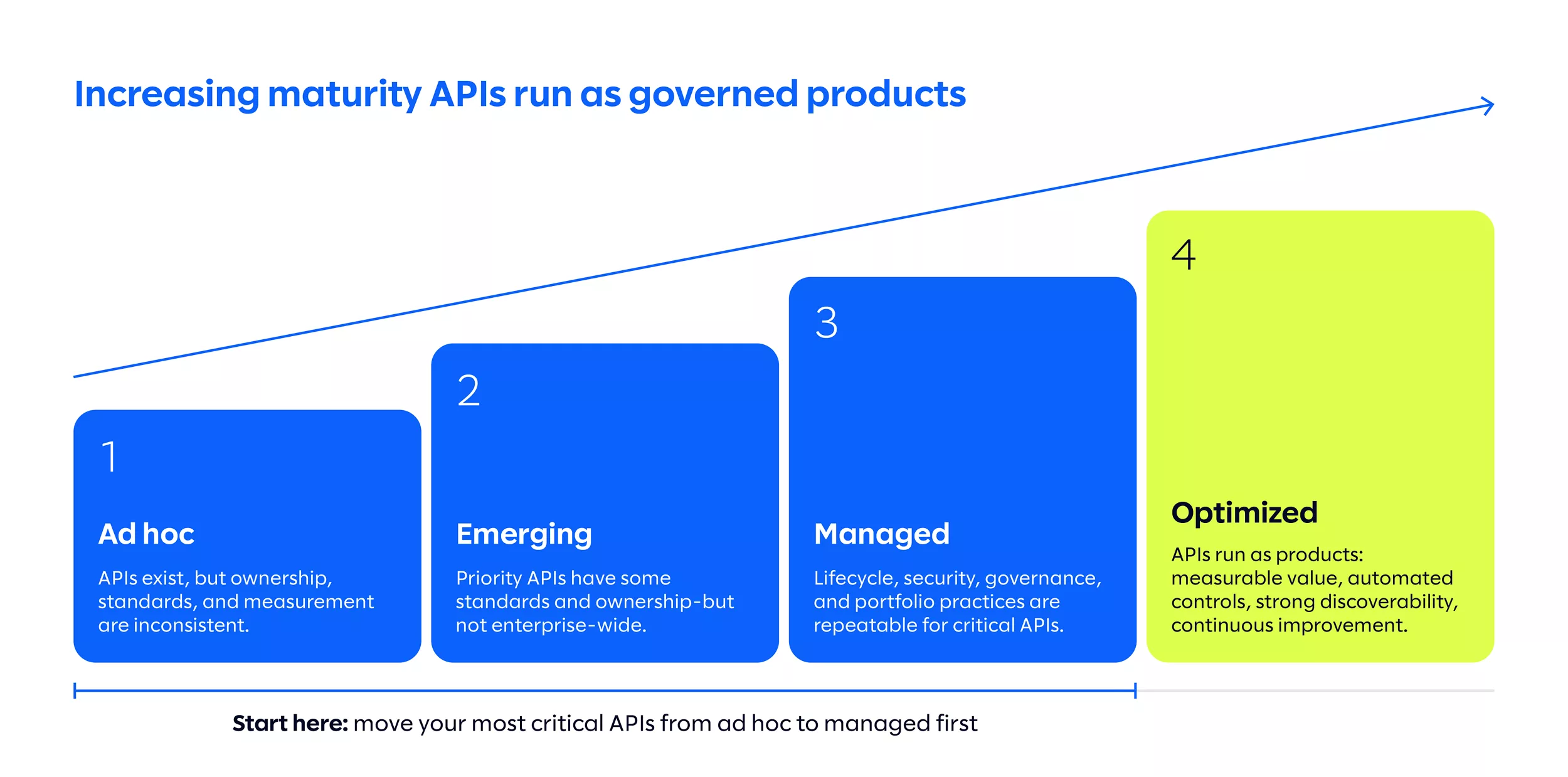
Here’s what each stage looks like in practice:
- Ad hoc. APIs get built when they’re needed, but ownership, design standards, security controls, and measurement are inconsistent or absent. Things work until they don’t—and when something breaks, it’s hard to say who owns it.
- Emerging. Your most important APIs have some standards, documentation, and named owners, and a few good patterns exist. But the practice lives in pockets of the organization rather than being shared enterprise-wide.
- Managed. For your critical APIs, lifecycle, security, governance, and portfolio practices are repeatable and predictable. New APIs follow known patterns, and you can answer basic questions about ownership, usage, and risk with confidence.
- Optimized. APIs are run as products end to end—measurable business value, automated controls, strong discoverability, and a continuous-improvement loop fed by real usage data.
Two things make this lens useful. First, maturity is per-discipline: you might be managed on security but ad hoc on portfolio management, and that gap is exactly what’s worth surfacing. Second—and this is the part most teams get wrong—the goal isn’t to push the entire portfolio to optimized. It’s to move the APIs that matter most from ad hoc to managed first, then extend the pattern outward. That focus is what turns a maturity model from a wall chart into real progress.
Where to start: A 30-to-60-day play
Now that the six disciplines are defined, the next step is prioritization. You don’t need to fix everything, and you can’t mature every capability at once. The practical move is to find where the pain is sharpest and act there first. Use the symptom you’re feeling today to choose the discipline that should lead your next 30 to 60 days.
|
If you’re seeing |
Start with |
Your first 30–60 days |
|---|---|---|
|
Unknown inventory, unclear ownership, rising cloud costs |
API portfolio management + API infrastructure |
Inventory your critical APIs, map ownership, and flag cost and runtime hotspots. |
|
Inconsistent design, duplicate builds, confused consumers |
API governance + digital marketplace |
Set lightweight design standards, publish your priority APIs, and improve docs and onboarding. |
|
Manual publishing and slow onboarding |
Platform services |
Map the lifecycle bottlenecks and automate the steps that are already repeatable. |
|
External exposure and inconsistent authentication |
API security |
Identify high-risk APIs, set minimum controls, and prioritize remediation. |
|
Pressure to prove API value and ROI |
API portfolio management |
Define a few KPIs and stand up a dashboard for your business-critical APIs. |
Whatever you pick, start with your most critical APIs and move them from ad hoc to managed first. That single step—visibility, ownership, and basic controls on the APIs that matter most—delivers more than a sprawling program that tries to boil the ocean.
How Slalom can help
API strategy works best when it connects ambition to execution. Slalom helps you move from a fragmented API estate to a governed, reusable, secure, and measurable API product ecosystem—without turning the work into a heavy transformation program.
A practical first step is a focused API strategy working session to align on the highest-value API use cases, identify current maturity by discipline, and choose the first moves that will create visible progress.
Your next move
If you take one thing from this: stop counting APIs and start running them like products. Pick the symptom that’s costing you the most right now, choose the matching starting point, and give your most critical APIs clear ownership, standards, and visibility over the next 60 days. That’s how a sprawling API estate becomes an engine for growth, resilience, and AI-ready services.
The future of API strategy is less about building more endpoints and more about making the right capabilities easy to find, safe to use, and valuable to the business. Start with the APIs that matter most, choose the discipline that unlocks the next step, and build momentum from there.