
Solving EV infrastructure challenges with data and AI
At a glance
vision
We partnered with Scheidt & Bachmann Energy Retail Solutions to build a proprietary AI algorithm that uses predictive insights to improve the availability and utilization of electric vehicle charging stations.
IMPACT
SIQMA FlowMax.AI reduces uncertainty at the charging station—strengthening customer trust, improving utilization, and supporting the broader shift to e-mobility.
Key Services




Industry
Mobility
Key Technologies / Platforms
- Amazon Web Services (AWS)
- Amazon SageMaker
Ready to transform your business model with data and AI?
The e-volution: Transforming traditional business models
Last year, electric car registrations rose 41% in Germany. Nearly one in five of all new cars purchased in the country are now battery powered. Demand for electric vehicles continues to grow, and the transformation is in full swing. But this shift often collides with reality: slow expansion of charging infrastructure, non-transparent charging rates, limited charging capacity, and a lack of visibility into the exact location of charging points all hinder the EV experience.
Founded in 1872, Scheidt & Bachmann is a pioneer in the mobility sector, developing innovative solutions in parking, signaling, fare collection, and energy retail. Scheidt & Bachmann Energy Retail Solutions is known for its services and products for gas stations and now aims to revolutionize the e-mobility market.
The goal: Solve well-known infrastructure challenges, such as the “tariff jungle” and the discoverability and availability of charging stations. At a gas station, customers generally know how long they’ll wait and what it will cost to refuel. This is not the case at charging stations.
“E-mobility is growing rapidly, but it will only become accessible to everyone if it is transparent, reliable, and has a user-friendly infrastructure. This is precisely where we are taking responsibility and actively shaping the future of charging,” explains Jörg M. Heilingbrunner, managing director of Scheidt & Bachmann Energy Retail Solutions.
Scheidt & Bachmann set out to develop a predictive AI solution that uses data and machine learning to make forecasts, creating transparency and confidence where uncertainty once prevailed. SIQMA FlowMax.AI would alleviate infrastructure challenges by improving utilization, price transparency, discoverability, and availability of charging stations.
“E-mobility continues to gain ground and will dominate the entire market in a few years,” explains Florian Kampes, head of AI & Ecosystem at Scheidt & Bachmann Energy Retail Solutions. “We want to underscore our pioneering role by transforming our business model early and continuing to offer our customers unique solutions that don’t yet exist. SIQMA FlowMax.AI is such a product.”
The human factor: Predicting the unpredictable
This proprietary, predictive AI solution needed to meet Scheidt & Bachmann’s exacting quality standards. To this end, the company first wanted to conduct a technical feasibility study to determine whether it was possible for a cloud-based app on AWS to capture information on charging stations and individual charge points. The application needed to show exactly where charge points were located and the cost to customers to charge their vehicles. The most challenging feature: The app should predict how many minutes were likely to pass before an occupied charging station would be available again.
For this function, the app would have to forecast unpredictable human behavior. Charging takes more time than traditional refueling. But other factors—like the customer’s desired charge level, the availability of nearby cafés, restaurants, and shopping, or even whether a family needs to keep children occupied—need to be taken into account.
Together with Scheidt & Bachmann, our team took just four weeks to develop a proof-of-concept solution to predict this behavior. We based the algorithm on combined data sourced through open interfaces, purchased data, and well-grounded assumptions. “Within the first five minutes of a charging session we were able to accurately predict when a charging point would become available again. Slalom’s data and AWS expertise helped us quickly develop, scale, and implement the pilot while acquiring vital know-how. This kind of rapid AI pilot is now a success factor for all our AI projects,” says Kampes.
From pilot to implementation: Bridging wish and reality
After successfully completing the proof of concept, we moved the solution into a working model for live operation. But live deployment brought a surprise: there was a significant gap between the training data and the real-world data seen in operation. As a result, the prediction accuracy was initially low.
Through additional hyperparameter training and experimenting with more data—such as location, day of the week, time, weather, and nearby amenities—we significantly improved the model’s predictive power and reduced the error rate. Our team also connected direct data pipelines to ensure new data continually flows into the model, retraining it regularly and steadily improving prediction accuracy. “We have a prediction accuracy of just a few minutes. This makes SIQMA FlowMax.AI an extremely complex solution that already excites customers and electric vehicle drivers by making the nearly impossible possible,” explains Kampes.
To ensure solution quality and track accuracy, we established a new KPI—the mean average percentage error. This value shows the average percentage deviation of actual charging time from the predicted time. If the value rises significantly, the team is alerted to intervene.
Comprehensive, end-to-end solution for the future
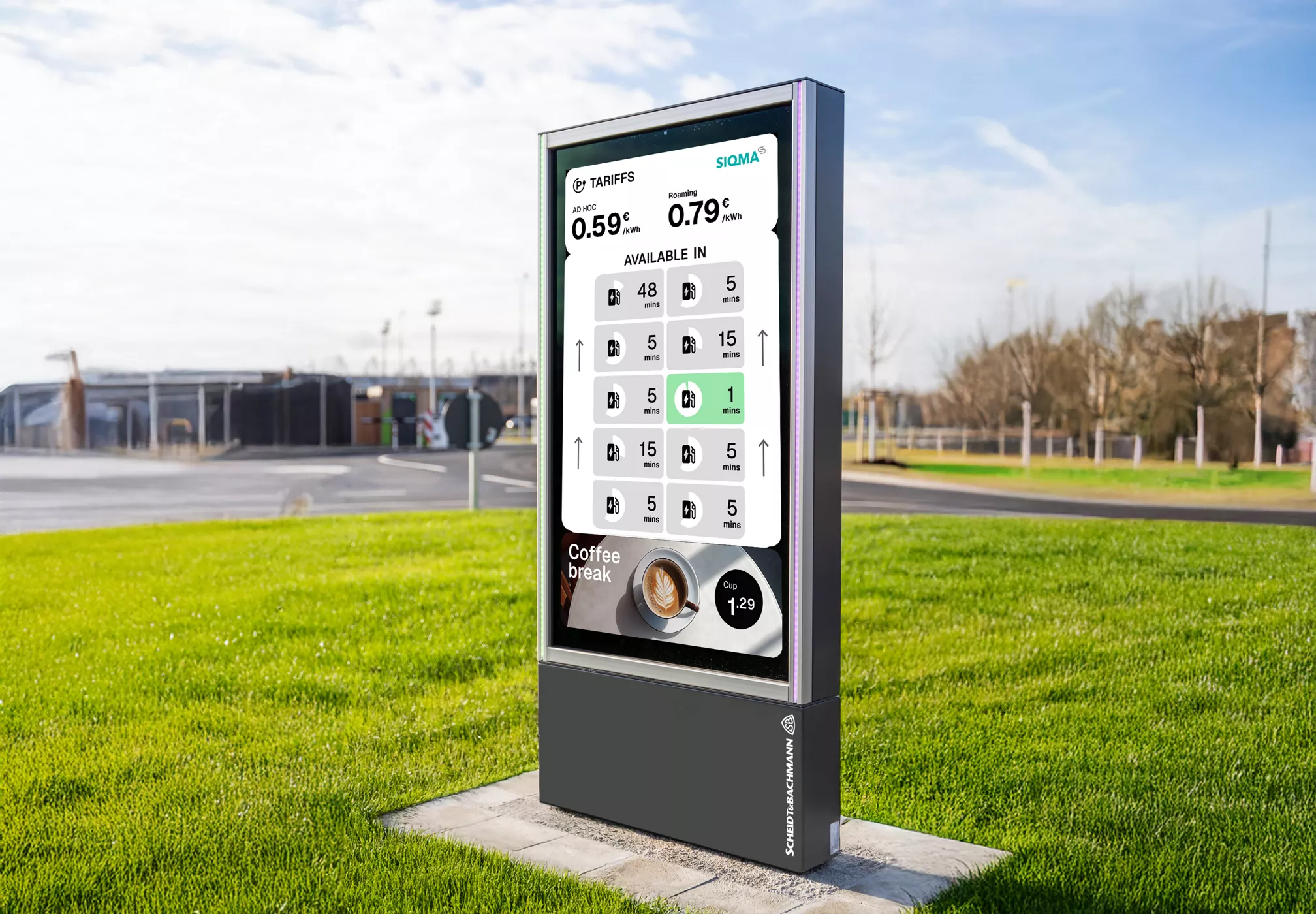
Gas and charging station operators can now purchase SIQMA FlowMax.AI together with the digital screen SIQMA Sign. The screen displays the current price for standard and fast charging at station entrances, and customers can check the availability of charging points, where they’re located on site, and what other amenities are available. The content management system also allows for advertising integration.
“In combination with the screen, our customers can improve charging station utilization and offer seamless charging experiences that strengthen customer loyalty,” says Kampes. The solution is already in use in a charging station with 24 charge points where data is continuously collected to help further optimize the algorithm.
The solution can also be purchased separately. Customers who only want to use the proprietary SIQMA FlowMax.AI solution can acquire the interfaces from Scheidt & Bachmann and integrate the solution into their own platforms and applications.