
Dreamforce 2026: Salesforce is changing where and how work gets done
Published:
8 minute read
TL;DR
- Salesforce is showing up wherever the work happens. AIforce and Claudeforce are extending Salesforce data, workflows, and actions beyond the traditional interface.
- Building the agent is only the beginning. As agents take on more work, organizations need to rethink how people and agents work together, including permissions, handoffs, governance, and measurement.
- Enterprise AI is becoming an architecture decision. Data, integration, context, governance, and interoperability increasingly determine what agents can know and do.
- Agentic AI changes the economics as well as the technology. Consumption and outcome-based pricing make cost and ROI important design considerations from the start.
- The opportunity now is turning AI investment into business value. Salesforce is making AI increasingly central to its strategy; customers need to be equally deliberate about where it can improve measurable outcomes.
What Slalom saw, heard, and learned about Salesforce’s next chapter in AI
Salesforce’s AI story felt different at Dreamforce this year. It was showing up in more places and taking on more of the work.
In Claude. In the tools bankers already use. In patient-service workflows. In shopping experiences off your website. We saw agents move beyond answering questions and taking action across customer service, sales, marketing, underwriting, appointment setting, and many other business processes.
And as AI moved deeper into the work, your decisions became more consequential. Data and integration shaped what agents could know and do (and not do). Governance became part of how they operate. New consumption and outcome-based models raised practical questions about monitoring cost and predictable ROI. And Salesforce made clear that AI is becoming increasingly important to its own growth strategy.
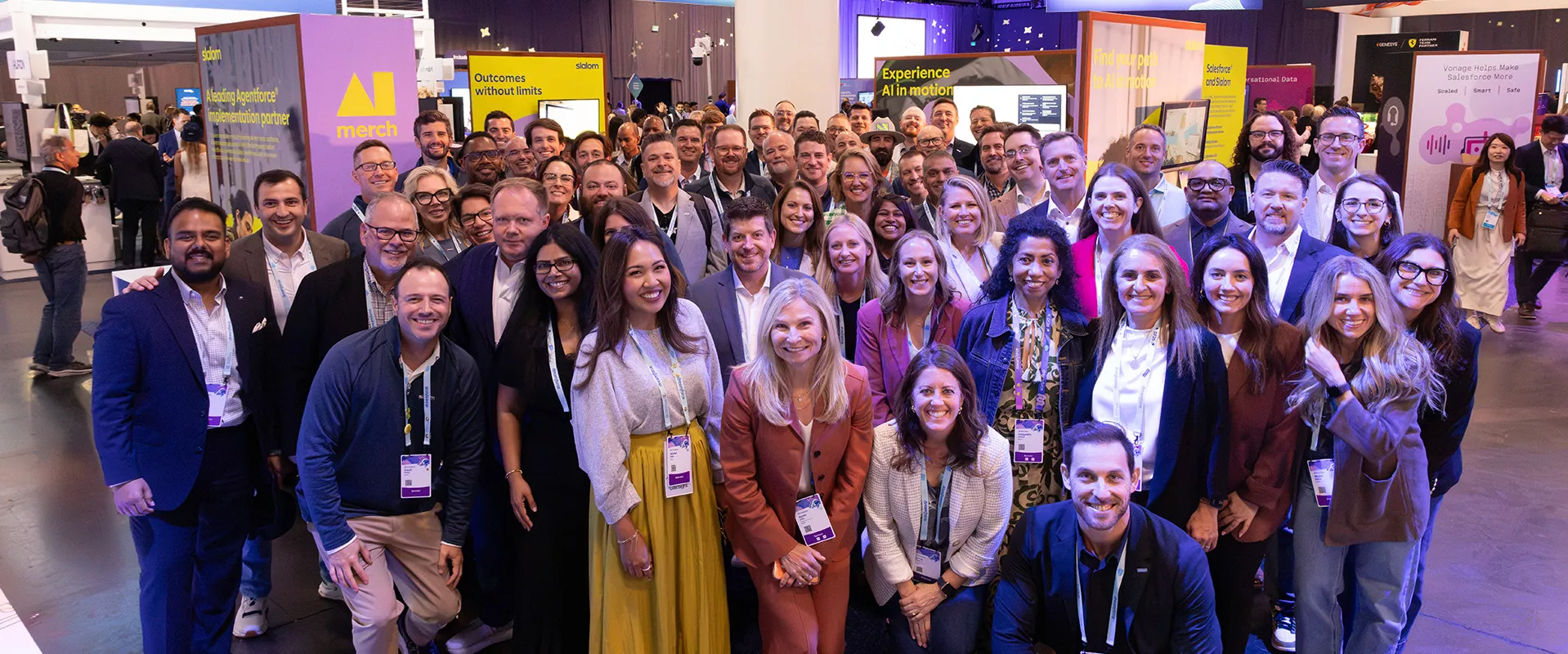
The 200 Slalomers who attended Dreamforce experienced those shifts across financial services, tech, and healthcare to architecture, integration, marketing, commerce, and customer experience. When we compared our notes on flights home, the same ideas kept coming up.
Here are five we’re bringing home with us.
1. The next Salesforce experience might not look like Salesforce
One of Dreamforce’s biggest storylines started before the event itself.
Across Dreamforce, Salesforce capabilities were moving beyond the traditional interface and into the tools and experiences where people already work. In financial services, for example, we saw Salesforce data and processes working outside Salesforce Lightning through secure Model Context Protocol (MCP) connections, creating opportunities for simpler experiences for bankers and service teams while Salesforce remains the trusted system of record behind them.
It’s a direction Slalom has already been exploring through our work on headless Salesforce. And with a hat bar at our Dreamforce booth celebrating themes from data to AI, we couldn’t resist the irony of talking about a future that may be increasingly headless.

Complex screens can become an adoption barrier, while experiences designed around a particular role, customer, or employee make the work easier. Easier experiences support better adoption and better CRM data, which becomes even more valuable as agents and teams work together and rely on each other to reason and act. By adding Voice interactions across the platform, we’ll see new ways to interact with customers and the CRM database.
In late August, Salesforce and Anthropic announced Claudeforce, an expanded partnership that brings Salesforce data, workflows, business logic, actions, and governance into Claude. The first product, Salesforce in Claude, launched with 37 prebuilt sales skills that connect sellers to live Salesforce as context for AI tasks while maintaining existing permissions and business rules.
The more interesting part of Claudeforce is what it suggests about where people will interact with Salesforce. Claudeforce works in multiple directions: Salesforce in Claude, Claude in Salesforce, and Claude in Slack.
Dreamforce also gave us a clearer picture of where Claudeforce fits into Salesforce’s larger AI strategy. A clearer distinction emerged between Agentforce as the layer where work gets executed and AIforce as the headless interaction layer that makes Salesforce capabilities available across AI experiences. Claudeforce puts that idea into practice with Claude, connecting it to Salesforce data, workflows, permissions, and actions.
That changes the starting question for Salesforce’s customers. Instead of assuming every process needs to bring someone into Salesforce, ask: Where does the work naturally happen, and what should Salesforce make possible there?
2. Building an agent is only the beginning
Agentforce arrived at Dreamforce with growing evidence that organizations are putting agents to work. In its most recent earnings, Salesforce reported that Agentforce annual recurring revenue had surpassed $1.5 billion, up more than 240% year over year.
In advance of the event, Salesforce also introduced a new portfolio of Agentforce agents designed for high-value work across sales, service, commerce, employee experience, and back-office functions. At Dreamforce, a broader shift came into focus: AI is moving from helping people do the work to doing more of the work itself.
In customer service, Salesforce showed Fin, the $3.6 billion acquisition with the best-in-class support LLM. In financial services, agents were moving beyond answers and recommendations to act across real business processes, with multiple agents increasingly able to work together across roles, systems, and stages of a workflow. Agentforce Operations and Fin Operator went a step further, showing how agents can examine a process, identify where work is slowing down, and recommend improvements.
Once agents do more of the work, the decisions around them change. Organizations have to decide what an agent can handle independently, where people need to remain involved, how permissions and handoffs should work, and how to measure whether the new way of working is actually better and at what cost. The Slalom panel discussion on buying and selling “consumption” was incredibly enlightening on the state of tech product design, deployment and usage monitoring.
That operational reality showed up in other parts of Dreamforce, too. Salesforce’s AI Harness and AI Control Plane pointed to governance becoming more integral to how agentic systems operate. MuleSoft’s Agent Fabric raised a related question: how do you architect for agents from the beginning instead of waiting until you have “agent sprawl” to manage?
For customers, one piece of advice came through particularly clearly: start with the business problem, not the agent. Define the KPIs and outcomes you need to improve and the work that needs to change first. Then determine what an agent should do, what should stay with people, and what data, connections, permissions, and guardrails that new way of working will require.
3. Salesforce’s AI story is becoming a platform story
Some of the most consequential product news at Dreamforce happened underneath the agents themselves.
Across Data 360, MuleSoft, AIforce, Tableau, and Salesforce’s industry clouds, more of the infrastructure needed for AI to work across data, systems, and applications was coming into view. Individually, these looked like product announcements. Together, they started to look like an emerging architecture for enterprise AI.
Data 360 is a good example. Salesforce expanded zero-copy connectivity and continued building out the business context agents need to reason and act across enterprise data. Tableau is moving in a similar direction, with richer semantic context, greater support for unstructured data, and broader MCP support that extends governed analytics available to external assistants and applications.
Integration is changing along with it. MuleSoft’s story was shifting from API-led integration toward AI governance, with Agent Fabric focused on managing agents across multi-technology environments. Across sessions, context, policy, headless interaction, and interoperability through MCP also emerged as increasingly distinct parts of the Salesforce architecture.
The same pattern fits Salesforce’s industry products. In financial services, agents are increasingly being connected to end-to-end processes across banking, wealth, insurance, lending, compliance, and collections. In insurance, Salesforce’s modular approach could give organizations greater flexibility to add individual capabilities alongside existing core platforms rather than replace them outright.
For customers, the practical takeaway is to evaluate these capabilities together. A new agent may depend on decisions about Data 360, integration, governance, or systems outside Salesforce. Looking at those connections early can help clarify the crawl-walk-run investment path.
4. The economics of agentic AI are still taking shape
Salesforce arrived at Dreamforce with momentum. Second-quarter revenue grew 11% year over year, net-new annual order value growth was its strongest in four years, and the company said it remained on track for organic revenue reacceleration in the second half of FY27.
At Investor Day, Salesforce reaffirmed its long-term financial framework, including a target of more than $63 billion in revenue by FY30 and a profitable-growth framework of 50. It also connected AI adoption more directly to that growth story: Salesforce says AI now appears in more than 80% of its top 100 customer growth stories.
Salesforce describes a “consumption flywheel” in which greater AI usage can lead to broader adoption across Agentforce, Data 360, Flex Credits, premium offerings, and the core platform. For customers, that raises a very practical question: How much will this cost, and how will you know you’re getting enough value in return?
We explored those changing economics in a Slalom-hosted Dreamforce panel on consumption and the emerging agentic economy.
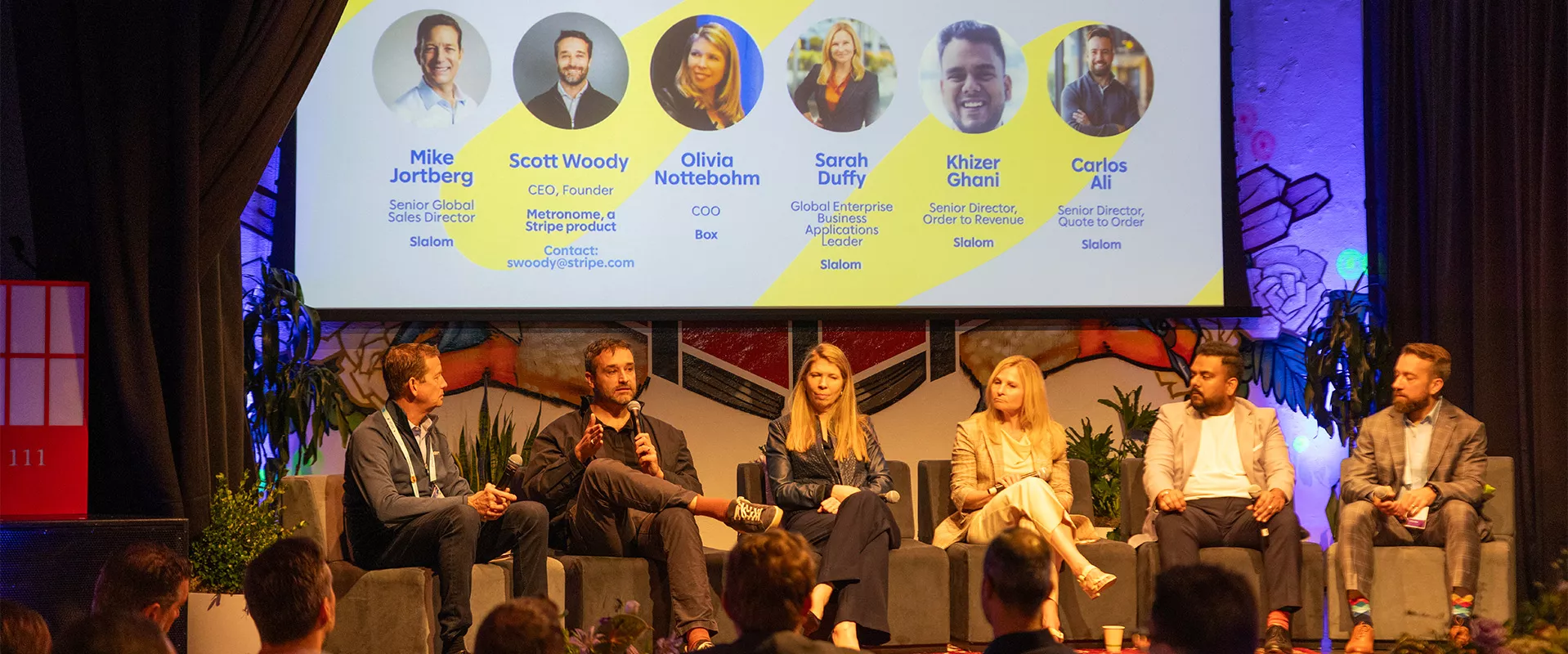
The pricing model is already evolving (rules announced on September 17). Each Agent will need to be registered, then as each agent runs, it will consume your Flex Credits as a “Headless Platform Interaction (HPI).” How much will that cost? It’s still to be determined as of September 2026.
Conversations at Dreamforce pointed toward a mix of subscription, consumption, and outcome-based approaches. Headless AI adds another consideration: Salesforce’s new rules for AIforce and Headless Toolkit call for agents interacting with Salesforce to have discrete identities, with usage tracked through Digital Wallet and Flex Credits.
That uncertainty makes ROI harder to forecast before an agent reaches production, a concern that surfaced repeatedly at Dreamforce.
For customers, the economics need to become part of the design. Before scaling an agent, test small, understand what will drive consumption, how you’ll measure the outcome it produces, and what that outcome is worth to the business.
5. AI is becoming core to Salesforce’s growth story
By the end of Dreamforce, Salesforce’s AI ambitions were hard to separate from the rest of its business.
Agentforce is moving into more jobs and business processes. AIforce is extending Salesforce data, workflows, and actions beyond the traditional interface. And Salesforce is increasingly connecting AI adoption to its own growth story.
Dreamforce also complicated predictions that AI will simply displace enterprise software. Claudeforce points toward frontier AI models and enterprise platforms becoming more closely connected, with Salesforce providing the governed data, permissions, workflows, and actions behind the experience. That creates new ways for customers to use Salesforce, even when the experience itself happens somewhere else.
Adoption won’t move at the same pace everywhere. In retail, some of the products getting the most attention onstage, like Salesforce Voice, aren’t necessarily seeing the strongest demand today in large enterprises. In life sciences, ambitious roadmaps are meeting the realities of regulatory specs, implementation steps and product readiness. And across architecture and revenue conversations, pricing and consumption remain important questions for customers to work through.
Dreamforce made Salesforce’s AI direction clearer. Now the focus shifts to what happens inside customers’ businesses: putting these capabilities to work and turning the investment into measurable value.
Five actions to take now
1. Workshop the agents
Workshops are the best ways to design where customers and employees work and determine what apps, data, and controls are needed to make them come alive.
2. Start with the business problem, not the agent
Define the outcome and the work that needs to change before deciding what a collection of agents should do. Are you and your data ready for voice interactions?
3. Design the architecture around the outcome
Consider data, integration, governance, agents, and existing systems together.
4. Model the economics before you scale
Understand what drives consumption and how. Together we’ll measure outcomes, and what those outcomes are worth.
5. Make value the test
Prioritize capabilities that can improve measurable business outcomes and focus on the KPIs that demonstrate that value.
What we’re taking home from Dreamforce 2026
By the end of Dreamforce, one thing felt clear: Salesforce and AI are becoming more deeply embedded in how work gets done.
That creates a lot of possibility. It also makes the choices around data, governance, people, and economics more consequential.
The strongest ideas we heard throughout Dreamforce came back to the same question: What work are you actually trying to make better?
That question helps clarify where an agent belongs, what data and systems it needs, where people should stay involved, and whether the economics make sense.
Dreamforce showed how quickly Salesforce and AI are evolving. The opportunity now is to be just as deliberate about where they create value.