
TIER 1
Visible (GEO/AEO)
Can AI find you?
- Products in shopping feeds
- Structured content & authority
- Well-placed prouduct descriptions
- Schema markup present
- AI crawlers allowed
In September 2025, OpenAI launched Instant Checkout inside ChatGPT. The pitch was hard to argue with: 800 million weekly users were already asking about products, why not let them buy right there? Shopify, Etsy, Walmart, and others signed on. It felt like the future of commerce had arrived. Six months later, it was gone.
Users loved ChatGPT for product research. The problem was everything that came after. Real-time inventory couldn’t sync across merchants. Sales tax compliance across jurisdictions wasn’t built. Fraud and payment systems weren’t designed for autonomous buyers. As Gartner analyst Bob Hetu told CNBC, “OpenAI underestimated how difficult the enablement of transactions was going to be.”
The failure wasn’t about demand. It was about infrastructure.
Here’s what makes that shift important: the merchants in the Instant Checkout experiment had strong brands, great content, and well-optimized product descriptions. By every generative engine optimization (GEO) and answer engine optimization (AEO) standard, they were ready. They still couldn’t transact.
The industry took notice. Google and Shopify introduced the Universal Commerce Protocol (UCP) at NRF 2026, with more than 20 endorsing partners. UCP is a new approach to making commerce systems directly accessible to AI agents—not through scraped pages or static feeds, but through structured, executable interfaces for products, offers, and checkout.
GEO is for models. AEO is for search. ADO is for commerce.
The industry has spent the last year debating GEO versus AEO within the broader shift toward the future of marketing. GEO focuses on influencing what models like ChatGPT and Gemini generate about you. AEO focuses on influencing what search-style AI like Perplexity and Google AI Mode retrieve and cite. Different mechanisms, overlapping tactics. Both are about discovery within an increasingly signal-driven marketing system—and discovery doesn’t disappear in an agent-driven world. It gets redefined.
As AI shifts from answering questions to completing tasks, discovery stops being about just visibility.
What gets surfaced is no longer just what’s relevant, but what’s executable. Products aren’t discovered simply because they match intent. They’re discovered because an agent can confidently evaluate them, apply policies, resolve identity and loyalty, and complete the transaction.
That’s what agentic discoverability optimization (ADO) is for. It’s the discipline of making your commerce infrastructure ready for AI agents: structured, unambiguous catalog data; contextually rich product and intent signals; checkout architecture; protocol endpoints; and payment integrations. Not what AI says about you. What AI can do with you.
The OpenAI pullback isn’t a failure of agentic commerce. It’s a clarification of architecture.
AI surfaces will own discovery. Google AI Mode, ChatGPT, Copilot, Claude, and Perplexity are already very good at helping people find products and compare options. Merchants will own checkout, where trust, compliance, and fulfillment live. Protocols will bridge the two. Google’s Universal Commerce Protocol is live, with Walmart, Target, and more than 20 partners onboarding.
The agentic commerce protocol (ACP) continues to evolve. These aren’t vaporware concepts — they’re the plumbing being laid right now. The question for every merchant is simple: when an AI agent sends a customer your way, or interacts with your systems on their behalf, is your agent-native infrastructure ready?
Can AI find you?
Can AI work with your data?
Can AI transact with you?
Most brands are at Tier 1, where visibility is the focus. They’ve invested in structured content, product feeds, and SEO-like tactics that make them easy for AI systems to find. That’s where GEO and AEO get you. That foundation is necessary—but it’s also where everyone is.
The competitive advantage starts to emerge in Tiers 2 and 3. Tier 2 is where agents can actually work with your data, where product information is structured, consistent, and machine-readable enough to support evaluation without guesswork. Tier 3 goes a step further, enabling agents to complete transactions through defined interfaces.
The gap between 1 and 3 is where the real investment needs to happen.
At Slalom, we’ve developed a structured assessment to measure visibility and execution readiness grounded in a pattern we see repeatedly: brands with excellent content readiness and near-zero execution readiness.
When we apply our agentic readiness assessment to a merchant, the gap becomes clear. On the surface, many brands appear well positioned. Their products show up in Google and Bing with pricing, images, and ratings. From a GEO and AEO perspective, they’re firmly in Tier 1. But the infrastructure layer tells a different story.
Product data is often loosely structured, with prices stored as text instead of typed values. Availability often lives in free-form descriptions instead of standardized fields. Key identifiers like GTINs are missing or inconsistent. Variants are embedded in product titles rather than modeled as distinct offers. Checkout flows still depend on browser-based interactions, with no API endpoints an agent could reliably invoke. The result is a disconnect: highly visible, but not programmable. That gap is invisible to GEO and AEO. It’s exactly what ADO measures.
Across the retailer groups we analyzed (Exhibit A), readiness remains uneven and consistently constrained by execution-layer gaps. Shopify-led DTC brands score highest overall (score of 54), driven by stronger protocol exposure and relatively more programmable checkout surfaces. Big-box omnichannel retailers improve meaningfully when participation signals are counted, but still rely heavily on distribution strength rather than true execution readiness. Department stores and home and furnishings lag behind, with modest gains in protocol but limited underlying infrastructure. Premium apparel brands perform well in distribution and catalog structure but show minimal protocol exposure, limiting their ability to support agent-driven transactions.
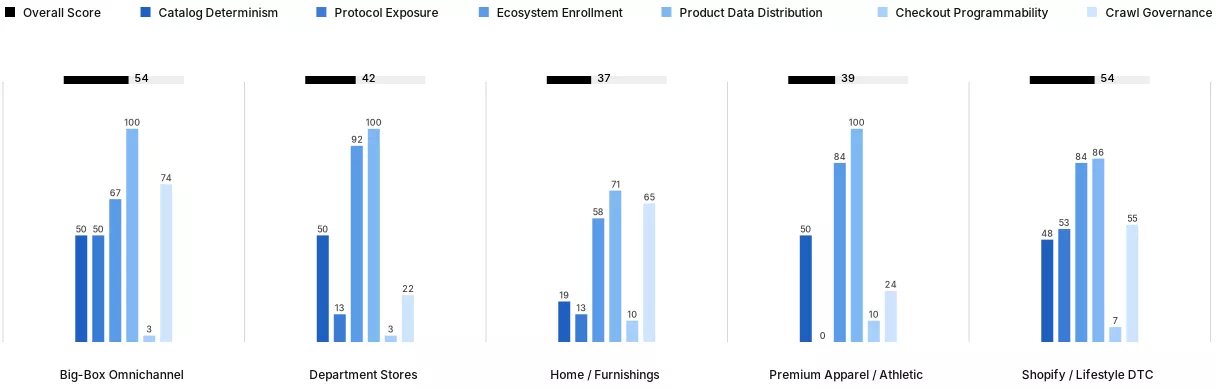
Here’s something that often surprises people: a Shopify merchant can be enabled across multiple AI agent surfaces (ChatGPT, Copilot, Perplexity, and Google AI experiences) through relatively lightweight configuration in their admin. No one optimized content for that. It’s a platform decision that cascades into multi-surface exposure.
Similar patterns are emerging elsewhere. Salesforce is introducing native UCP support in Agentforce Commerce, giving merchants on Salesforce Commerce Cloud prebuilt integration with Google AI surfaces. PayPal’s Store Sync connects merchants into Copilot and Perplexity ecosystems. Stripe is enabling agent-compatible payment flows with minimal integration effort.
For some brands, the most impactful ADO move isn’t schema remediation. It’s choosing platforms that handle the protocol and distribution layers natively.
Morgan Stanley Research estimates agentic shoppers will intermediate $190 billion to $385 billion in U.S. e-commerce spending by 2030, capturing up to 20% of online retail. Gartner predicts 60% of brands will use agentic AI for direct consumer engagement by 2028. They also warn that 40% of agentic AI projects will be canceled by 2027 because the infrastructure isn’t ready (that failure rate isn’t specific to commerce, but the root cause is directly transferable).
That last number is the one that matters most. The ambition is there. The infrastructure—and the ability to operationalize it—isn’t. The brands that close that gap in 2026 will be the ones agents route transactions to when the volume shows up. Those that stop at visibility—with strong content, GEO, and AEO—will be mentioned by AI but unable to differentiate.
The conversation about optimizing for AI has focused on content. Now it’s time to focus on agent-native surfaces. At Slalom, we’ve built the ADO assessment and supporting frameworks to help brands unify AI visibility and execution, closing the gap between what agents can see and what they can do.
Contributors: Damyant Gill and Nick Miller